The Mindset Shift We Must Make Right Now

Under the True Constitutional Republic we are Restoring, each county is a Sovereign Steward
What the 1849 Constitution Actually Says About Counties.
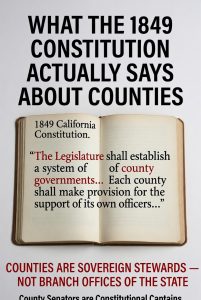
- The Legislature shall establish a system of county and town governments…
- The Legislature shall have the power to provide for the election of a board of supervisors in each county…
- Each county… shall make provision for the support of its own officers…
Notice what it does NOT say:
It does not say one state bill must apply uniformly to all 58 counties.
It says the Legislature sets up the system — but each county is expected to run its own affairs, support its own officers, and act as a real government.
Current Issues That Prove We Need Real County-Level Legislation:
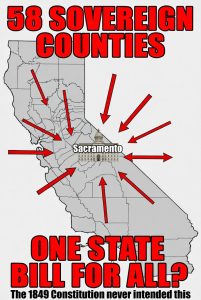
Think about the crises hitting our counties right now:
- Toxic soil and water contamination in rural counties from old industrial sites or fires. One statewide “environmental” bill can’t fix Paradise’s burned soil the same way it treats San Mateo’s tech runoff. Each county needs its own restoration authority — now.
- Property taxes and housing mandates forced down from the state level that ignore local realities. A county senator should be able to write county-specific relief that actually fits the people living there.
- Education and Wisdom Academies — why should one Sacramento bill dictate what our children learn when each county knows its own families best?
- Land use and agriculture — rural counties need fiber-waste-to-bio-fuel hubs. Suburban and urban counties need distribution networks. One state bill cannot possibly steward 58 different economies.
Yet we keep trying to solve 58 sovereign counties with one state bill. That is the old centralized mindset talking.
Why We Need County Senators Writing County Legislation?
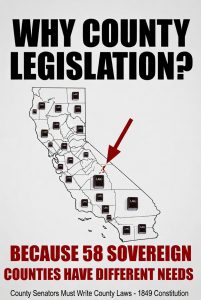
The county senator is the constitutional captain of the county ship.
- First duty: Guard the county’s inalienable rights against state or federal overreach.
- Second duty: Steward the county’s own prosperity (land restoration, bio-fiber economy, sovereign energy, Wisdom Academies, etc.).
- Third duty: Give every county an equal voice at the state table — not as subordinates, but as sovereign partners.
The BOS is no longer the only recognized government body.
One State Bill for 58 Sovereign Counties? Really?

Why would 58 sovereign counties — each with its own geography, economy, people, and challenges — ever accept one single state bill written in a distant capital as the final word?
The 1849 framers never intended counties to be rubber stamps.
The Mindset Shift:
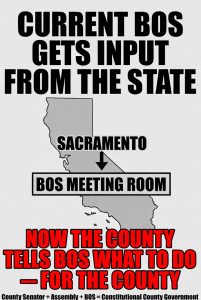
The constitutional republic mindset flips it:
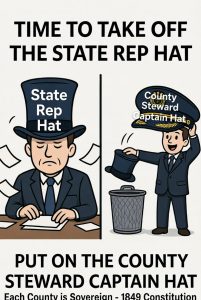
The BOS, county senator, and county assembly work for the county, not for the state.
Current BOS Legislation Examples (Old Mindset)
Here are real, everyday examples of how BOS currently function under state direction:
- Housing mandates (SB 9, SB 10, etc.): BOS must approve high-density housing projects even if the local community opposes them, because the state sets the quotas.
- Wildfire & environmental rules: BOS must adopt state-mandated fuel reduction plans, zoning changes, and CEQA rules, even when they conflict with local rural realities.
- Tax and fee increases: Many counties are forced to implement state-passed sales tax extensions or new fees (e.g., transportation or climate adaptation taxes) without true local consent.
- Public health & education policies: During COVID or on school curriculum, BOS often rubber-stamped state directives rather than passing county-specific ordinances that fit their people.
- Land use & agriculture: State laws override local zoning for “climate-smart” farming or solar projects, even when the county wants to protect prime farmland or rural character.
In every case, the BOS is acting as a state enforcement arm, not a sovereign county government.
The Constitutional Way: County Senator + County Assembly + BOS
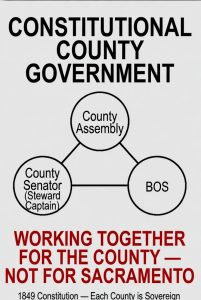
How it works in practice:
- County Senator : The constitutional steward and captain of the county.
- Primary duty: Protect the county’s God-given rights and inalienable rights from state or federal overreach.
- Writes county-specific legislation (ordinances, resolutions, charters) that serve the county’s unique needs.
- Brings the county’s voice equally to the state table — not as a subordinate, but as a sovereign partner.
- County Assembly (the people’s voice): Elected representatives from districts inside the county. They debate and pass local laws alongside the senator and BOS.
- Board of Supervisors (BOS): Still handles day-to-day administration, budgets, and local ordinances — but now receives its primary direction from the county senator and assembly, not from Sacramento.
Together they form a county-level constitutional government:
- The senator and assembly set the policy direction rooted in the 1849 Constitution.
- The BOS executes and administers it.
- No single state bill can override the county unless the county voluntarily agrees.
This is iron sharpening iron — the senator, assembly, and BOS work as partners, not as top-down bosses.
Other Government Officials
- Sheriff: Constitutional officer — elected by the people, answers to the county, not the state. Can refuse unconstitutional state mandates (e.g., certain gun control or immigration enforcement rules).
- District Attorney / Public Defender: Serve the county’s justice system, not state directives that conflict with local rights.
- Assessor, Clerk, Treasurer: Handle county finances and records independently.
- All other officials: Their loyalty is to the county charter and the people, not to Sacramento bureaucrats.
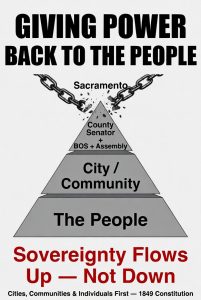
The goal: every elected official inside the county sees themselves as a steward of the county’s sovereignty, not a cog in the state machine. Giving Power Back to the City, Community, and the People
This is the beautiful part of the 1849 model:
- Cities and towns inside the county can pass their own local ordinances on issues that don’t affect the whole county (zoning, business licenses, parks, etc.).
- Communities can use referendums, initiatives, and town-hall votes to decide major local issues.
- The people regain direct sovereignty through:
- County-level initiatives and referendums (easy to trigger).
- Nullification of unconstitutional state mandates at the county level.
- Local charters that give cities and neighborhoods real autonomy.
Example: A rural county could pass its own bio-fiber restoration ordinance and sovereign energy pilot without waiting for a state bill. An urban city inside the county could pass its own Wisdom Academy funding measure. The county senator’s job is to protect that local power, not to override it.
This is how we return sovereignty to the people:
Each county protects its own people.
Each county has an equal, sovereign voice. That is the New California we are building.
New California State
Restored California